

It was a brutally contested game on Sunday at the MCG.
139 stoppages were the most in any game for nearly two seasons, and the combined total of 184 tackles were also the most in any game this year.
Those stats, in pretty good conditions no less, meant it wasn’t the typical game to cast an eye over.
Today’s post is in the jump around format. We’ll touch on a variety of things from general game style, then a couple of individuals, before finishing with a look at the last few minutes.

—
The Patreon is up and running once again for 2025, which you can find right here. The three tiers are much the same as previous years, with refined features for the top two.
In addition to Patreon, you can find me on Twitter – and also Bluesky, where vibes are much more pleasant and there’s much less hate. It’s nice, even though there’s not a large AFL community yet.
—
Personnel adjustments
It’s not a coincidence North Melbourne’s game looked better almost immediately after Harry Sheezel’s switch to half back in Round 7 against Port Adelaide.
That, plus the introduction of Riley Hardeman (into the 22), allowed North to have two primary distributors (Caleb Daniel + Sheezel), a secondary distributor (Hardeman), and allowed the keys to simplify after the omissions of Griffin Logue and Aidan Corr.
So deciding to shift Sheezel back to his midfield-forward role was not without risk for how it could influence the team as a whole, as Finn O’Sullivan was entrusted with the high half back role in the defensive rotation.
Sheezel’s move meant a return to the six-man on-ball rotation, joining the usual suspects. And the extra tweak around the ball was seeing Colby McKercher – more on him later – come further up the field in his half forward role, along with playing as the third winger which he hadn’t done in the last fortnight with Zane Duursma in the side.
It made for plenty of subtle tweaks for a team who had no changes to the 23 and one change to the 22 (Bailey Scott in for Duursma). There’ll be another change next week if Paul Curtis is ready to resume from his suspension and the reported quad tweak sustained in training.
For the relative stability in personnel – 14 players to play all 10 games and a further two only missing one – there are still alterations being made to individual roles.
I promise this whole section wasn’t a prelude to plugging the week-by-week structure graphics that are normally exclusive to $10 Patreon subscribers, but it is the perfect way to illustrate this:

For the most part, the changes worked as intended. Perhaps in a different type of game, moving Sheezel away from half back might have been more noticeable. Maybe next week against Collingwood on a faster track at Marvel Stadium his role will change again.
But on Sunday, when the game was stoppage-tackle-stoppage-tackle-repeat, things went largely according to plan.
Stoppages and tackles and stoppages and tackles
As mentioned in the introduction, the MCG saw 139 stoppages on Sunday. Not only was it the most in any game this season, it was the most in any game since Brisbane v Adelaide in Round 11, 2023.
In addition, the teams combined for 184 tackles. That number was also the most in any game this season, dating back to Adelaide v St Kilda in Round 18 last year (if my counting is correct there, at least).
Lots of stoppages. Lots of tackles. They’re not exactly the ingredients for a free flowing, open, and conventionally attractive game. And because of it, the pressure numbers were consistently high.
In a game like this, arguably the most important thing in tight is to ensure the stoppage losses – because there’s going to be a fair share – aren’t clean and going to the opposition’s advantage in space.
To only concede six scoring shots (albeit all goals) from Richmond’s 33 clearances is, in my opinion anyway, a tick. With most of those scoring shots coming from losses further down the field rather than a direct flow on from clearances – Scott losing a contest with Hugo Ralphsmith on the wing and Corr getting done twice in a matter of seconds from contests he should have halved at worst, for instance – it’s hard to pinpoint too many foundational issues from stoppages on the day.
Given Tim Taranto (85% game time, 81% centre bounce attendances), Jacob Hopper (87% game time & 89% CBA) and Toby Nankervis (86% game time & 96% CBA) were ever presents for Richmond, to hold up as a collective around stoppage and contests under immense pressure is a major tick, even if it earned negative style points along the way.
—
For those who have missed it, the last five North match analysis pieces on The Shinboner, plus…
2025’s Team Structures Page
North Melbourne’s Round 9 analysis v Brisbane
North Melbourne’s Round 8 analysis v Essendon
North Melbourne’s Round 7 analysis v Port Adelaide
North Melbourne’s Round 6 analysis v Carlton
North Melbourne’s Round 5 analysis v Gold Coast
—
Toby Pink
The game saving mark in the final minute will take most of the attention, as will the chase down tackle earlier in the quarter.
But the most impressive play of Pink’s last term was his intercept mark on the interchange wing, setting in motion a chain of events which led to a Nick Larkey goal.
Because George Wardlaw beat Nick Vlastuin hands down in a ground ball contest seconds later, Pink’s intercept mark was, perhaps understandably, quickly overshadowed to the point there was no replay to show how much ground he had to make up.
When Ben Miller took possession in Richmond’s defensive 50, Pink was a mile away from Seth Campbell on the wing. In a fraction of a second Pink had to read the cues and make the decision on whether to come off his opponent and try to intercept. Get it wrong and it’s more than likely a walk in goal for Richmond.
But Pink got it right in a high risk-reward moment and North reaped the benefits.
Although Pink’s game was far from perfect, with a couple of notable errors, to hold Tom Lynch to two goals (one of which came direct from the ruck) is a major win. And in the bigger picture it hopefully sends a message to Logue. If there’s no underlying injuries we’re unaware of, there’s no reason Logue should be languishing in the VFL.
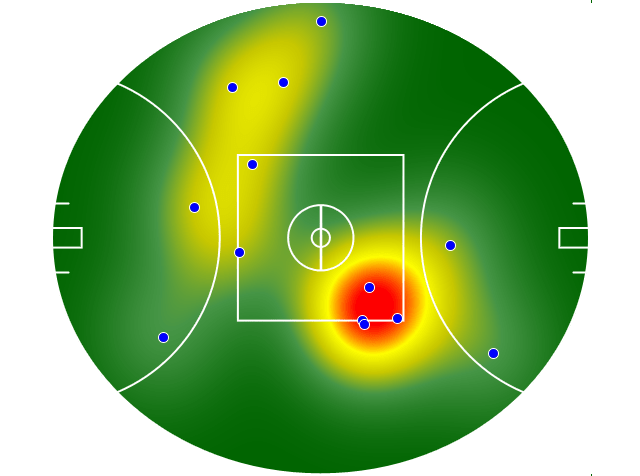
Colby McKercher
Here’s McKercher’s heat map from Round 9 v Brisbane…
…compared to his heat map from Round 10 v Richmond:
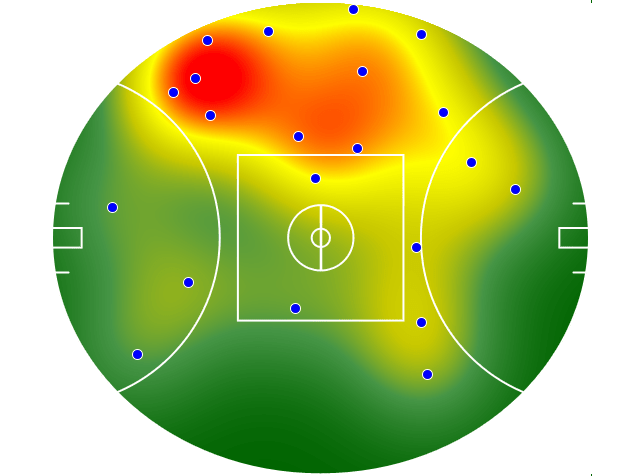
Going from a ‘standard’ high half forward role, to one that included a little bit of on-ball time, along with third winger minutes behind Scott and Dylan Stephens, had the desired effect.
During the week Alastair Clarkson talked about where McKercher will settle long term, with the bolded words my own emphasis:
“He’s finding his feet in terms of half forward, wing, a little bit of on-ball, we think that’s where he’s going to end up playing. The challenge of putting him in a position where he can win a little bit more of the footy and help us, which he did last year, and trying to nurture him in the position he’s likely to play long-term in his footy career – that’s a balancing act.”
The bolded basically described McKercher’s role against Richmond to a tee and he responded with the best game of his season by far; probably only behind his 37-disposal, 666 metres gained effort against Gold Coast last year on his career podium.
The most pleasing parts of McKercher’s game were two-fold:
1) Finding the confidence to take the game on, while…
2) Not taking the game on too far
The second part can become a bit confusing sometimes, and tough for younger players to find the balance on.
For someone in McKercher’s role, if he takes the game on ‘too far’, it can actually hurt the connection with forwards as they lead up at the ball and trying to work with each other. It’s why the long, mazy runs aren’t a constant feature in today’s game and instead we see plenty of short, powerful runs with ball in hand. Break the lines – find the next option in the chain – take the metres gained.
It’s tricky to illustrate without proper full ground footage, but the next time you’re at a game look at the forwards as soon as someone gets the ball and starts running. If the player in possession doesn’t take the first or second option you see presenting, often the team’s chain hits a dead end.
Earlier in the season McKercher didn’t have that balance quite right as he came to terms with his new role. It was much better against Richmond on Sunday.
—
The Create Your Own Depth Chart feature is now part of the List Management suite, all on the $5 tier for Patreon subscribers:

You can subscribe to the Patreon for 2025 right here. The three tiers are much the same as previous years, with refined features for the top two.
—
The last few minutes
After last week, and the two before that, there was plenty of intrigue on how North would approach the final quarter of a close game. This time, with the benefit of a lead, the answer we got was essentially ‘shut up shop too early’.
It’s important to say the decision was perfectly understandable given what’s transpired over the last three weeks, along with North not being on their own league-wide in making this decision. For instance, we almost saw Adelaide throw away the Showdown last week by choosing to do the same.
We know that shutting the offensive part of play down invites pressure, and it’s a fine balance in protecting a lead that only the best sides do well. And even then, sometimes it’s sketchy. The point of this section today is to look at how it played out defensively.
Although the slow down had started well before this, if we pick play up after Taranto’s miss with about four and a half minutes left and play it out from there, we only see one moderate error defensively.
It was Tristan Xerri’s hit-out with about 80 seconds left from a boundary throw in which went outside the stoppage bubble and landed here:

As we’ve talked about after close games last year, the goal when protecting a close lead is if you can’t stop play in possession then keep the ball in congestion as often as possible – the exact opposite of what the above hit-out achieved.
Thankfully it went unpunished, Xerri rectified his mistake at subsequent stoppages, and North were able to hold on and record victory number two for 2025.
But after all that, perhaps the coup de grace of the last few minutes, unmentioned until now, was finding the same umpire* who didn’t play holding the ball against Ben Cunnington in the 2015 Elimination Final to also not pay insufficient intent against Luke Davies-Uniacke in the back pocket with 90 seconds left.
(*For the record, this isn’t actually true but it made me laugh as a way to finish today’s piece, so it stays in)