

Saturday saw more in-game tweaks from North Melbourne than at any other time this season.
Movement around midfield, and the domino effect for other lines, suggested a small – but notable – step forward in the comfortability of adding another layer to the team’s style.
Up until this point the magnet shuffling had largely been either pre-match, or straight forward moves influenced by injuries, substitutes, and a late match ‘let’s give this a shot because why not’ mentality.
Given it was also the last game before a much, much, much-needed bye, it serves as a convenient time to double a look at Saturday with how the team has evolved so far this season.
—–
While the North Melbourne match analyses are – and always will be – free for all, for those who want a little bit extra the Patreon continues to run. There are three tiers available in 2024:
$2.50 – Debutant – To show support for the site without receiving any extra features
$5 – Rising Star – The first level where there are extra features and early access for certain things
$10 – Brownlow – First access to everything and anything set up for Patrons
To find out more details and sign up, head here for the Patreon page.
—–
For the first time this year, Darcy Tucker played behind the ball at half back, shifting from his regular spot on the wing.
He was also joined from time to time by either of the main wingers for the day, Bailey Scott and/or Curtis Taylor.
It’s because North opted to bring up Liam Shiels from, technically, a half forward starting position to become a defensive midfielder, tagging Zak Butters in the first half and Jason Horne-Francis in the second.
So instead of having an extra player in the midfield, North looked to create an extra defender behind it. Usually it was Charlie Comben, when the game was still up for grabs at least, but sometimes the responsibility fell to Aidan Corr as well.
To summarise:
- Shiels comes up from half forward to play midfield
- One winger, Scott or Taylor, drops to half back if possible
- North have an extra defender; usually Comben, but sometimes Corr
It was a new tactic from North. Not only was it a defensive move – looking for more security behind the ball in stopping Port’s creation of space over the back – but the goal was to help offensively as well, giving more numbers to help transition the ball out of their defensive half.
In the constant search for ball use and rebound, what looks to be the preferred defensive structure is taking place.
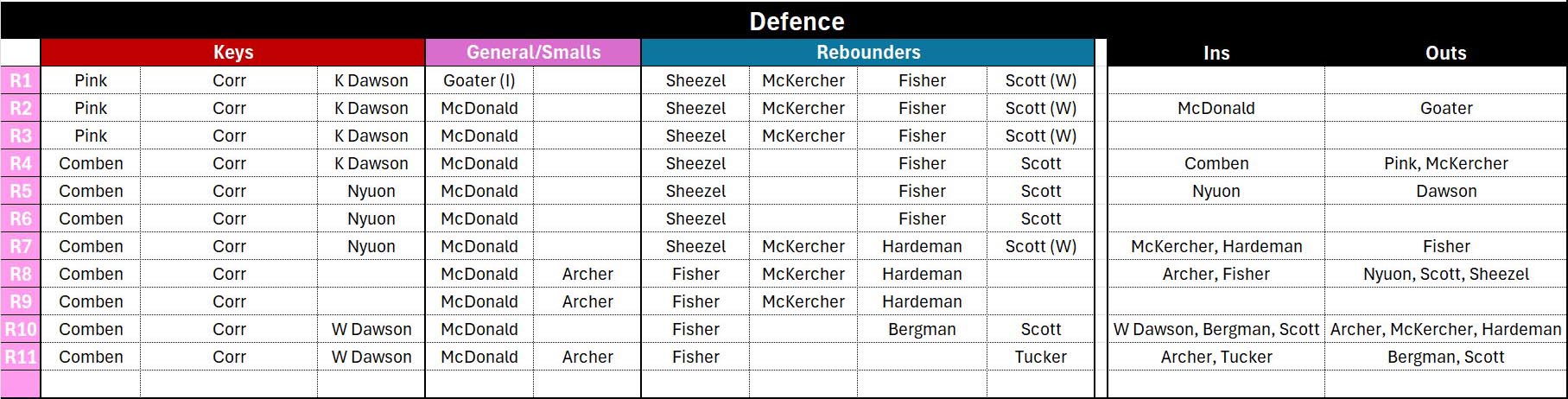
Playing three key talls appears to be the first step. Sticking with Bigoa Nyuon for multiple weeks, and then calling up Wil Dawson ahead of schedule – after only a fortnight playing with two keys – seems to indicate as much.
With Luke McDonald asked to play in a variety of tricky roles on medium and tweener forwards, rotation data suggests the remaining three spots in the defensive unit ideally fall to players the coaches trust to rebound.
Because this week was the first where only two names fall in the ‘rebounders’ category, it offers another reason for dropping a winger back behind the ball.
With Jackson Archer a pure defender at the moment, dropping nearly the entire rebounding responsibility on Zac Fisher and Darcy Tucker would have been a bridge too far.
Having another body back there to spread the load noticeably helped in the first half. North were able to hold up relatively well moving the ball outside defensive 50 and getting it into their own forward half.
21 rebound 50s turning into nine inside 50s is well ahead of the league average of roughly 25 percent. It’s admittedly a small sample size, but nevertheless something to note going forward.
Although it’s likely a temporary move, judging by Alastair Clarkson positivity of a Colby McKercher (and Jy Simpkin) return after the bye, it can be filed away in the back pocket if needed for further experimentation.
Through 11 games, the three keys + McDonald + three rebounders – however it gets to the latter number – appears to be the preferred choice if availability allows.
The midfield rotations have changed slightly, perhaps most noticeably on the wings: Scott and Taylor a different pairing to even just a month ago when Dylan Stephens and Tucker were the preferred duo.
Mostly it’s been a main pair all year, with spot minutes from a third player who’s changed nearly by the week. This structure is relatively commonplace across the competition, with only slight tweaks here and there from team to team.
Even allowing for what we’ve just talked about with the wingers dropping back when possible against the Power, Scott is much better as a starting winger and moving from there rather than half back and moving up.
At the bottom of the Round 4 Brisbane post, I wrote the following and all of it still stands (lightly edited for space):
It’s not as if Scott has played badly in the back half. It’s more that his skill set isn’t best utilised as a half back, which speaks to the difference between that role and the wing.
Scott has most influence on a game playing as a link man – normally the second or third key step of a possession chain – charging up and down a wing all day.
More often than not, half backs are asked to create – the first key step of a possession chain. It’s a subtle difference but highlights why Scott has been merely okay through the first month at half as opposed to times over the last two years where he was one of North’s best on a wing.
There’ll be turnovers from time to time, which isn’t to downplay Scott’s role in causing a number of simple ones. But in the big picture, Scott is a winger primarily and that’s where he helps the team most with his running patterns. Externally, wingers are the most underappreciated role in a team, bar none. Much of the good work goes unnoticed and the errors are glaring. Paging Sam Gibson…
Nevertheless, the other wing remains open for discussion, and I wouldn’t be surprised if it continues rotating post-bye. While Tucker is given different responsibilities, Taylor has played the last fortnight, Stephens is in the VFL, and there are a handful of others essentially playing for their careers who will likely get a chance at some stage.
—–
For those who have missed previous match analyses, here are links to the last five weeks:
An individual focus: Round 10 v Essendon
Opening the mailbag: Round 9 v Gold Coast
Positional changes: Round 8 v St Kilda
Back to front: Round 7 v Adelaide
Trust on a football field: Round 6 v Hawthorn
—–

Part of Shiels coming up from, nominally, a half forward position, was North’s inability to stop opposition midfielders from having their way once in possession.
In Round 1 I offered slight surprise that the on-ball rotation was relatively skinny. It’s grown steadily since then – and won’t be a problem in 18-24 months’ time – but for the time being, a lot is asked of a few.
Perhaps that’s a part of opponents scoring at will from clearances, North second last* for points conceded per 100 clearances lost.
(*Only ahead of West Coast, although the Eagles’ setup is part by design because they basically play Russian Roulette at plenty of stoppages)
Either way, in bringing Shiels up to tag Butters, he held the Power midfielder to no influence in the first half. Only a couple of goals from Butters saved him from being anonymous and me getting wildly frustrated at making him my Supercoach captain.
But because Port have a deep midfield, they were able to regroup and change tack. They handed the keys to Jason Horne-Francis, allowing him to go full send at every stoppage knowing no Roo was capable of going with him and there was a safe structure backing him up. It’s not a luxury North have.
In time George Wardlaw will take a little more of the two-way responsibility, but at the moment he’s not capable of doing it for 100 minutes every week. And that’s perfectly okay too, someone with his checkered pre-draft injury history can’t be expected to reach his final form after only 18 AFL games.
When that happens though, it’ll unlock more of Harry Sheezel’s strengths, Tom Powell’s as well, and give North more flexibility with mixing and matching combinations.
Post-bye, once Simpkin returns, we’ll likely see something close to North’s preferred on-ball rotation for the rest of the year, something along the lines of:
- Davies-Uniacke and Wardlaw as the main two
- Sheezel as a close third
- Powell not far behind
- Simpkin playing as a forward/mid
- Curtis and Zurhaar floating in and out as required
- Shiels filling gaps as much as his body allows
- All pending availability
It’ll be a big step from the season opener, when it was Davies-Uniacke, Wardlaw, Powell, and a bit of Lazzaro, which was it until Zurhaar was thrown in almost as an afterthought after half time.
All that will also influence the forward rotations and structure as well, which I’ve spilled many words on already this season…

…I don’t know how many new things I can offer here.
We all know the areas of improvement with the forward pressure, as covered most in detail post the Adelaide game.
We also know there’s no magic wand coming to instantly fix the issues. It’s going to take time and hard work to both gain experience and fix individual flaws.
It’s why the two biggest list holes – for me, anyway – are a second key forward and a genuine small forward. They’d open up the offensive process, which in turn would make it easier to defend. Think of it this way:
- A second key forward who commands attention spreads the opposition defence
- It then allows North more options to move the ball, whether short with chip and run, or long to targets
- Genuine small forwards arguably do their best work at the feet and around of an aerial presence, either winning the ball or locking it in
- Which then means opposition defences are spread out and/or conscious of ground level pressure
- If it’s the former, they can’t snap into offensive position as quickly
- If it’s the latter, they’re forced into rushed disposal which heightens their risk of turnover
But as far as I know, no one can click their fingers and make those two players appear out of nowhere.
It makes it tricky to assess progress elsewhere, because the lack of these two key forward pillars influences every other part of North’s game. However, the small steps we’ve noted together over the first half of the season can suddenly become noticeable strides once the personnel improve collectively.
In the meantime though, enjoy next weekend without a North game to watch.
